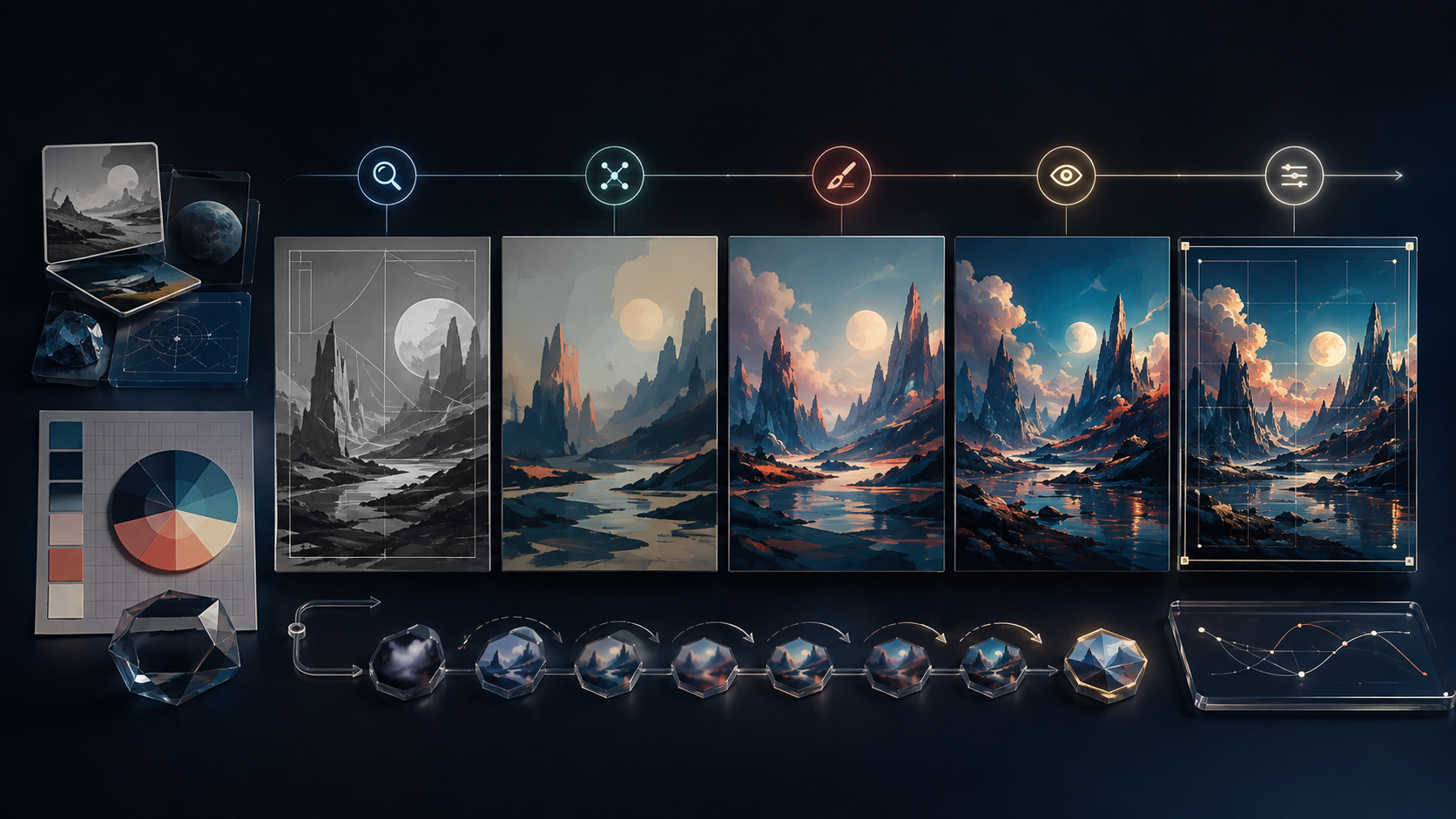
The first wave of generative imagery compressed a creative act into a single exchange: write a prompt, wait, and choose from the results. Better models improved fidelity and instruction following, but the fundamental loop remained one-shot. When something was wrong, the human had to diagnose it and prompt again.
Meta’s Muse Image announcement describes a different architecture. The image model can invoke search and coding tools, refine its own generations, and coordinate with the Muse Spark reasoning model. Visual creation begins to look less like a vending machine and more like a small production process.[1]
Tools fill factual gaps
A generative model can produce a convincing chart-like image without calculating the values behind it. It can imitate a QR code without producing one that scans. Giving the system a code execution tool creates another option: compute the graphic deterministically, render it, then condition image generation on that accurate result.
Search can play a similar role when the model lacks a reference needed for accuracy. The model first identifies an information gap, retrieves material, and then incorporates what it found. That is an important boundary: the final pixels are generated, but parts of the composition can be grounded in externally checked artifacts.
The visual model is becoming an orchestrator of rendering, retrieval, calculation, and critique.
Meta also reports that Muse Image can spend more inference-time compute on reasoning, tool calls, and self-refinement. In its internal ablations, deliberate refinement continued to improve preference scores after simply generating more candidates and choosing the best began to saturate. These are vendor-reported measurements, but the comparison identifies an important design choice: use extra compute to make more drafts, or use it to improve the process.[1]
Revision is the real frontier
Professional creative work depends on controlled revision. A useful system must change the requested element while preserving composition, identity, typography, and other approved details. Every iteration creates an opportunity for unintended drift.
An agentic loop can explicitly inspect those invariants. It can compare a result to the brief, identify a localized failure, select an editing operation, and check again. That does not guarantee taste or correctness, but it turns revision into a first-class part of the system rather than an improvised conversation.
More autonomy needs more provenance
When a media agent searches, writes code, combines references, and edits repeatedly, provenance becomes harder and more important. A final image may be influenced by retrieved material that the user never saw. Logs should make sources and tool actions visible, while durable provenance signals can help downstream platforms identify generated media.
Meta says images created with Muse Image in its products carry a hidden Content Seal signal designed to survive cropping, compression, resizing, and screenshots.[1] That approach is complementary to Content Credentials, whose C2PA specification cryptographically binds signed assertions about an asset’s origin and edits to the media itself.[2]
C2PA is deliberately a provenance system, not a truth detector: a valid credential can show that signed history has not been altered, but it cannot establish whether the depicted event is factual.[3] Agentic media systems will likely need both durable machine-readable provenance and interfaces that let people understand the sequence of searches, references, and revisions behind a result.
The shift is larger than image quality. Media models are beginning to reason about how an image should be made. The systems that win may be those that manage the entire path from intent to evidence to revision—not merely those with the most impressive first frame.
References
- Meta Superintelligence Labs, “Introducing Muse Image and Muse Video,” July 7, 2026.
- Coalition for Content Provenance and Authenticity, “Content Credentials: C2PA Technical Specification 2.3,” January 5, 2026.
- C2PA, “C2PA and Content Credentials Explainer,” specification guidance.